
Archbishop Hosam, Vice President of the Anglican Consultative Council, has addressed the meeting currently taking place in Belfast, Northern Ireland. The theme of the conference is "Called to one Hope." The Archbishop spoke of what it means to be a people of one hope in his Province, and took the opportunity to announce the celebrations for the two thousandth anniversary of Jesus' baptism in 2030.
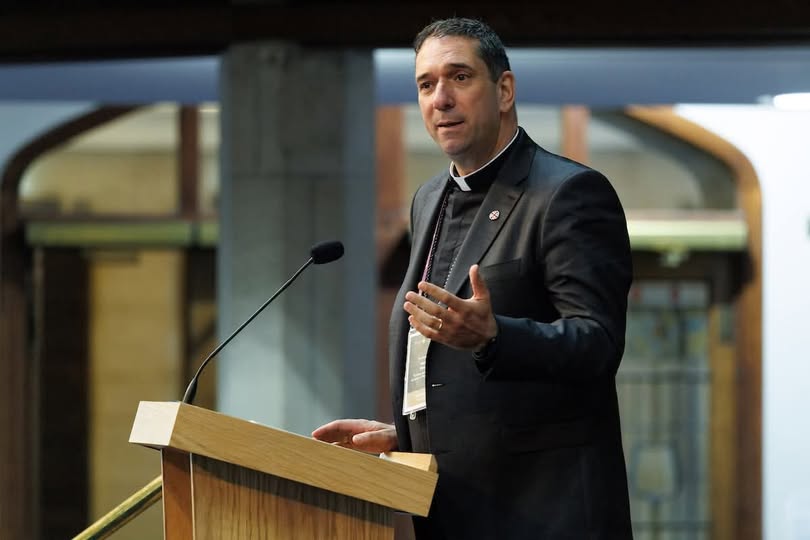
Grace to you and peace in the name of our Lord Christ.
It is a privilege to greet you on behalf of the Province of Jerusalem and the Middle East.
I bring you the prayers and greetings of our dioceses in Jerusalem, Cyprus and the Gulf, and Iran, together with the faithful clergy and laity who continue to witness to Christ in places where the Gospel has been proclaimed since the earliest days of the Church.
We gather under the inspiring theme, “Called to One Hope.” Those words from Saint Paul’s Letter to the Ephesians remind us that “there is one body and one Spirit, just as you were called to the one hope of your calling” (Ephesians 4:4). Hope is rooted in the risen Christ. It is sustained by the Holy Spirit. It is lived out in the fellowship of the Church.
Our meeting takes place during a moment of profound uncertainty in our world.
War continues to scar nations. Communities remain divided by conflict, fear and displacement. Many of our people carry deep wounds that statistics cannot measure. Around us we witness growing polarisation, economic hardship, forced migration, environmental crises, and an erosion of trust between peoples and nations.
The Anglican Communion does not meet apart from these realities. We gather from every continent, bringing with us the prayers, tears, hopes and faith of the people whom we serve. Around this assembly sit primates, bishops, priests, deacons and lay members whose churches know both joy and suffering, growth and challenge, peace and persecution.
For the Province of Jerusalem and the Middle East, these realities are especially immediate.
We serve in the land where our Lord was born, ministered, was crucified, rose again, and sent his disciples into the world. Yet our holy places have become surrounded by conflict that continues to affect every aspect of daily life.
In recent weeks, our Province has witnessed another dangerous escalation as military confrontation unfolded between Iran, Israel and the United States. The consequences reached far beyond national borders. Missiles crossed skies that connect our dioceses. Fear entered homes, churches, hospitals and schools. Families once again asked whether tomorrow would bring peace or further violence.
The Diocese of Jerusalem, the Diocese of Cyprus and the Gulf, and the Diocese of Iran have each experienced these events in different ways, yet together they remind us that conflict in one part of our Communion is never isolated from the rest of the Body of Christ.
When one member suffers, all suffer together.
The repercussions extend across our Communion. Many Provinces represented here today have welcomed refugees from our region. Many support humanitarian ministries that sustain life through schools, hospitals, clinics and development programmes. Many pray faithfully for the Christians of the Holy Land and the wider Middle East.
Your solidarity reminds us that communion is more than constitutional structures or historical relationships. Communion becomes visible whenever Christians bear one another’s burdens in the love of Christ.
This week in Belfast, our theme invites us to ask an important question:
What does it mean to be called to one hope when our world appears increasingly fragmented?
It means that Christian hope refuses to surrender to despair. Hope does not romanticise suffering nor denies it, rather, it inspires us to walk humbly with God in the spirit of discipleship. In other words, Hope is about presence and resilience in our Risen Lord.
It means that peace is not merely the absence of war, but the presence of God’s justice, mercy and healing.
It means that our diversity across cultures, languages and traditions becomes a gift rather than a barrier, because we are united in one baptism, one faith and one Lord.
Hope is the daily decision to continue serving Christ even when circumstances tempt us to give up.
The churches of the Middle East have learned that hope often takes very practical forms.
For example at our Anglican Hospital in Gaza: Hope is a doctor treating patients despite shortages.
Hope is a teacher opening a classroom after another difficult night.
Hope is a priest celebrating the Eucharist with a small congregation determined to remain.
Hope is young people choosing to build their future rather than surrender to fear.
Hope is every act of faithful witness that proclaims Christ is risen.
As we deliberate together throughout this week, may our conversations be marked by humility, careful listening and mutual encouragement. May we discern together where the Holy Spirit is leading our Communion. May our differences never eclipse our common calling in Christ.
From Jerusalem we continue to hear the words spoken by our Lord to his disciples: “Peace I leave with you; my peace I give to you.” (John 14:27)
That peace remains the deepest longing of our region.
I invite you, throughout this gathering, to remember Jerusalem in your prayers—not only the city itself, but all the peoples of the Holy Land, and indeed the whole Middle East.
As the Psalmist reminds us:
“Pray for the peace of Jerusalem: May they prosper who love you.” (Psalm 122:6)
And may that prayer never end with Jerusalem alone.
May the peace of Jerusalem become a blessing that reaches every nation represented in this Council.
As part of this hope, I warmly invite the Anglican Consultative Council and the whole Anglican Communion to support and promote the Royal Initiative of the Baptism of Christ 2030 in Jordan, marking two thousand years since our Lord’s baptism in the River Jordan. May Anglicans from across the world come as pilgrims, walk prayerfully at the Baptism Site, renew their baptismal calling, and carry from the Jordan a fresh witness to Christ, our one hope.
May the hope sprung from the Jordan River and shone from the empty tomb continue to strengthen our Communion.
And may Christ, our hope, make us faithful instruments of his peace wherever he sends us.
Thank you.